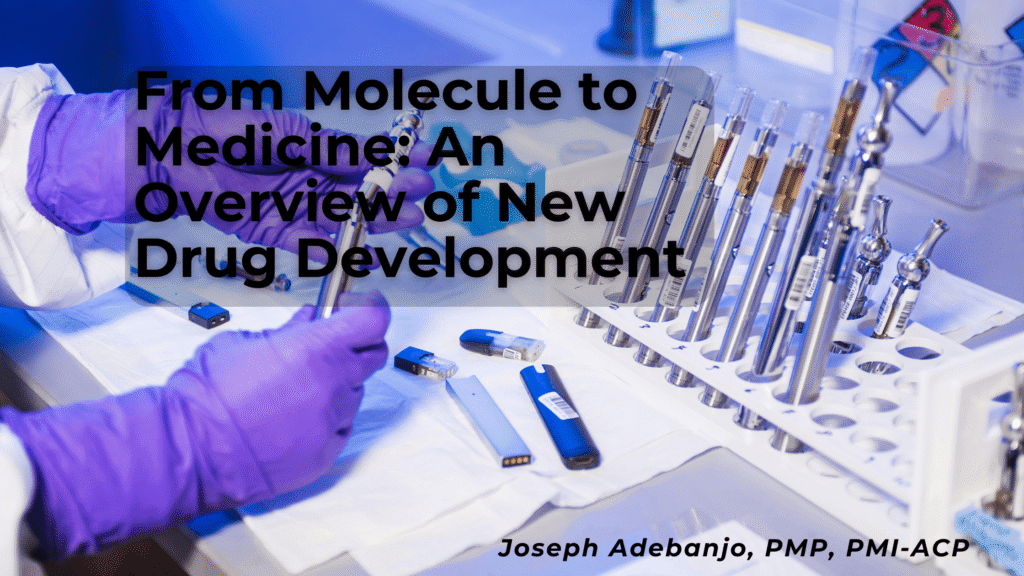

From Molecule to Medicine:
An Overview of New Drug Development
A PhD chemist and certified project manager breaks down the full drug development pipeline, GCP compliance, and what it actually takes to carry a candidate from discovery to FDA approval.
Bringing a single new drug to market takes an average of 10 to 15 years and costs more than $2 billion. Behind every approved therapy is a structured, rigorously regulated pipeline that demands both deep scientific expertise and elite project management discipline. Whether you are entering pharmaceutical R&D, regulatory affairs, or clinical operations, understanding that pipeline is not academic background reading. It is the foundational language of the entire industry.
The Drug Development Pipeline
New drug development is not a single event. It is a series of tightly sequenced phases, each designed to answer a specific scientific and regulatory question before the next gate opens. Think of it as a staged-gate process where each milestone either unlocks the next phase or terminates the program entirely. Most candidates are stopped. That is the system working exactly as intended, because the alternative is approving drugs that do not work or that harm people.
The pipeline broadly follows six stages: target discovery, preclinical research, and three phases of clinical trials culminating in regulatory submission and post-market surveillance.
Target Discovery
Researchers identify a biological target, typically a protein or gene, linked to a disease. Computational chemistry, genomics, and proteomics drive this work.
2–5 yearsPreclinical Research
In vitro and in vivo studies test safety and efficacy before any human exposure. Results must support a defensible Investigational New Drug (IND) application to the FDA.
3–6 yearsPhase I Trials
First-in-human studies with small cohorts of 20 to 100. Primary focus is safety, dosing, and pharmacokinetics. Approximately 70% of compounds advance.
1–2 yearsPhase II Trials
Efficacy signals are tested in a larger patient population of 100 to 500. Dose-response relationships and early safety signals are the primary study endpoints.
2–3 yearsPhase III Trials
Pivotal, multi-site studies in thousands of patients. Designed to demonstrate statistically significant efficacy versus the current standard of care. Failure here is catastrophic.
3–5 yearsNDA / BLA Submission
A New Drug Application compiles all preclinical and clinical data for FDA review. Standard review targets 10 months under PDUFA. Priority review targets 6 months.
6–12 monthsWhat Good Clinical Practice (GCP) Actually Means
If the drug development pipeline is the structure, Good Clinical Practice is the ethical and scientific foundation underneath it. GCP is an internationally recognized standard for designing, conducting, recording, and reporting clinical trials. It exists for two reasons: to protect the rights and safety of trial participants, and to ensure that the data collected during a trial is credible enough to support regulatory decisions that affect millions of patients.
GCP guidelines are established by the International Council for Harmonisation of Technical Requirements for Pharmaceuticals for Human Use (ICH E6). Compliance is not optional. It is the condition under which the FDA and other global regulators will accept clinical data in a marketing application. A trial conducted outside GCP cannot be used to support drug approval, regardless of how promising the results look.
The Three Pillars of GCP
- Participant Protection: Informed consent must be obtained before any trial procedure begins. Participants must fully understand the risks, potential benefits, and their unconditional right to withdraw at any time without penalty or loss of care.
- Data Integrity: All clinical data must be recorded accurately, completely, and in a way that allows reconstruction and independent audit. Falsification or fabrication of trial data is not merely a regulatory violation. It is a federal crime under 18 U.S.C. § 1001.
- Regulatory Compliance: Trials must comply with the approved protocol, FDA regulations (21 CFR Parts 50, 56, and 312), and ICH guidelines. Protocol deviations must be documented, reported to the IRB where required, and corrected through a formal CAPA process with verified effectiveness checks.
GCP compliance is not a bureaucratic checkbox. It is the reason we can trust that the drugs on pharmacy shelves actually do what the label claims and do not harm the people taking them.
Core Principle — ICH E6(R2) Good Clinical Practice GuidelineThe Sponsor and the Monitor: Two Roles That Hold It Together
In any clinical trial, two roles sit at the center of GCP compliance: the sponsor and the clinical research associate, also called the monitor. Understanding both is essential for anyone building a career in clinical operations or regulatory affairs.
The Sponsor
The sponsor (typically a pharmaceutical company or academic institution initiating the trial) is responsible for the design, initiation, management, and financing of the clinical program. They hold the IND, bear ultimate regulatory responsibility, and must ensure that every investigator site is qualified, adequately trained, and continuously compliant throughout the duration of the study.
The Clinical Research Associate (CRA)
The CRA is the sponsor’s representative in the field. Their core function is site monitoring: verifying that participant rights are protected, that reported data is accurate and traceable back to source documents, and that the trial is running in conformance with the approved protocol and applicable regulations. Visit reports are the primary deliverable, and their quality is a direct reflection of the trial’s compliance posture.
Where Project Management Fits In
At its core, drug development is a project management problem at enormous scale. Each program involves dozens of contract research organizations, hundreds of investigator sites across multiple countries, thousands of enrolled patients, and a regulatory timeline with zero tolerance for critical path slippage. The discipline that holds this together is the same one codified in the PMP and PMI-ACP frameworks: stakeholder governance, risk identification and mitigation, schedule control, scope management, and quality systems thinking.
What separates a strong scientific contributor from an effective drug development leader is the ability to translate complex technical data into clear, actionable project decisions. A borderline Phase II result is not just a statistics question. It is a go/no-go decision with a $300 million Phase III program on the line. That decision requires professionals who understand both the science and the portfolio economics, and who can communicate across both worlds without losing precision in either direction.
GCP Competencies PM Professionals Should Build
- Working knowledge of the IND, NDA, and BLA submission process and regulatory timelines
- Familiarity with 21 CFR Parts 11, 50, 56, and 312 as they govern electronic records, informed consent, IRBs, and IND requirements
- Protocol deviation classification and CAPA documentation with verifiable effectiveness checks
- Clinical Trial Management System (CTMS) and electronic Trial Master File (eTMF) platform literacy
- Risk-based monitoring frameworks including the FDA’s 2013 guidance on oversight of clinical investigations
- Vendor qualification and third-party CRO oversight under ICH E6(R2) Section 5
The Regulatory Endgame: NDA, BLA, and Post-Market
When Phase III data is locked, the sponsor files a New Drug Application with the FDA for small molecule drugs, or a Biologics License Application for biologics such as monoclonal antibodies and vaccines. These are not short documents. A complete NDA may comprise hundreds of thousands of pages, organized into a standardized electronic Common Technical Document (eCTD) format that maps to specific FDA review divisions.
Approval can come with conditions attached: labeling negotiations, Risk Evaluation and Mitigation Strategies (REMS) requirements for high-risk therapies, or post-market Phase IV study commitments. The regulatory relationship with the FDA does not end at approval. It becomes permanent.
Whether you are targeting regulatory affairs, clinical operations, or R&D program management, fluency in the drug development pipeline and GCP fundamentals is your baseline entry credential. It is not specialized knowledge. It is the shared language of the industry. Earning CITI Program GCP certification before entering the job market signals to hiring managers that you have done the work to speak that language from day one.
Explore More at Project Precision
This post is part of an ongoing series on pharmaceutical R&D, GCP compliance, and scientific project management.
Visit projectprecision.com