
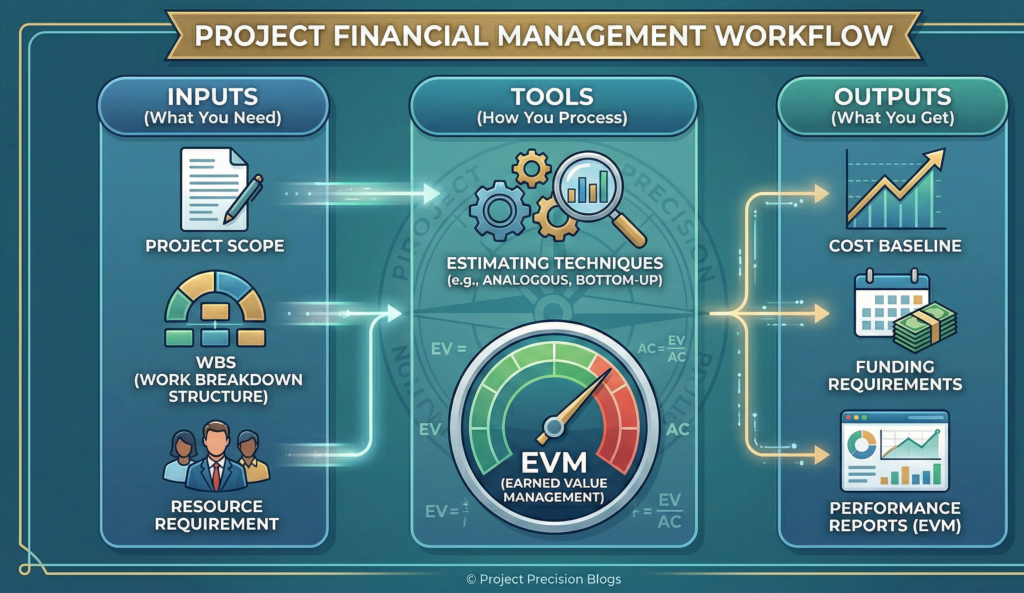
Managing the financial health of a project is often the difference between a successful delivery and a “failed” project that technically works but ruined the budget. In project management, financial management is a continuous loop of planning, tracking, and adjusting.
Let us look at it through the lens of Inputs (what you need), Tools (how you process it), and Outputs (what you produce).
1. The Inputs: What You Need to Start
Before you can manage a single cent, you need raw data. These inputs provide the “ingredients” for your financial plan.
- Project Scope Statement: Defines what work is included. You can’t estimate costs if you don’t know the boundaries of the work.
- Work Breakdown Structure (WBS): A hierarchy of tasks. Financial management is more precise when you attach costs to small, manageable “work packages” rather than one giant lump sum.
- Resource Requirements: A list of who (personnel) and what (equipment, software, materials) is needed.
- Market Rates: Current industry standards for labor and materials to ensure your estimates are grounded in reality.
2. The Tools & Techniques: The Engine Room
This is where the “precision” happens. These are the methodologies used to transform raw data into a financial strategy.
- Expert Judgment: Consulting with seasoned pros or historical data from similar past projects.
- Analogous Estimating: Using the actual cost of previous, similar projects as a basis for the current one (fast, but less accurate).
- Bottom-Up Estimating: Aggregating the costs of individual WBS components to get a total (slow, but highly accurate).
- Earned Value Management (EVM): The “Gold Standard” tool. It combines scope, schedule, and resource measurements to assess project performance and progress.
- Formula Example: $CV = EV – AC$ (Cost Variance = Earned Value minus Actual Cost).
3. The Outputs: The Results
The outputs are the documents and benchmarks that guide the project team and satisfy stakeholders.
- Cost Baseline: The approved version of the time-phased project budget. This is what you measure performance against.
- Project Funding Requirements: A forecast of when the money will be spent (e.g., “We need $50k in Q1 and $200k in Q2”).
- Performance Reports: Dashboards showing Burn Rates, Variance Analysis, and Forecasts (Estimate at Completion).
- Change Requests: If the financials go off track, the output is often a formal request to adjust the budget or the scope.
Summary Table: Financial Flow
| Phase | Key Deliverable | Purpose |
| Input | Resource Breakdown | Identify every cost driver. |
| Tool | Parametric Estimating | Use statistical relationships to calculate cost. |
| Output | Cost Forecasts | Predict future financial health based on current trends. |
Why This Matters
Precision in financial management prevents the “Iceberg Effect,” where hidden costs sink a project months after it starts. By strictly defining your inputs and outputs, you create a transparent environment where the Project Sponsor always knows the ROI.