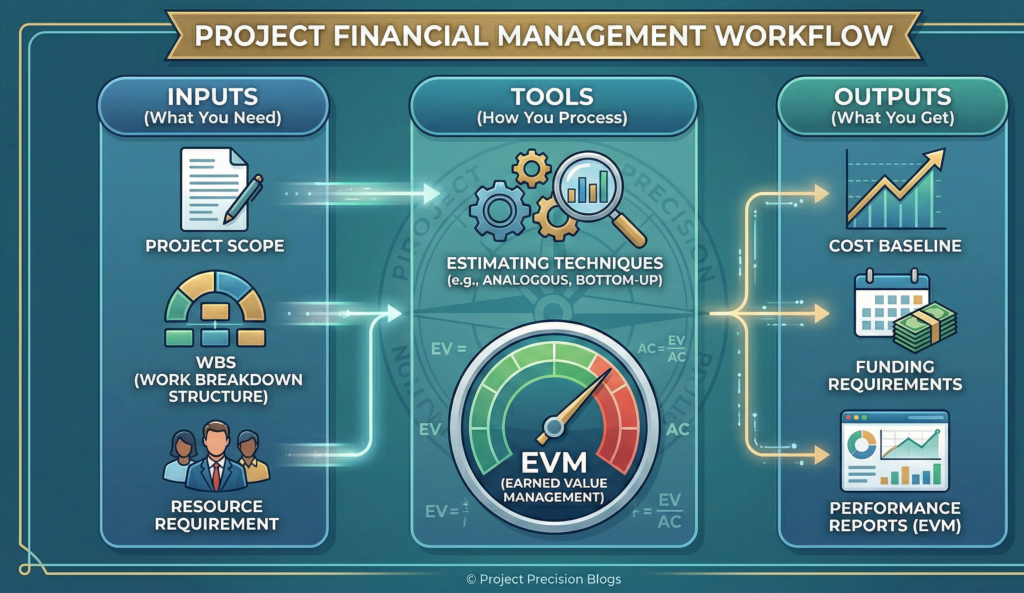

In our previous post on Financial Management, we discussed the high-level inputs and outputs required for a healthy project. Today, we’re diving into the “engine room” of project precision: Earned Value Management (EVM).
EVM is the gold standard for objective project tracking. Instead of simply asking, “How much money have we spent?” EVM asks: “What actual value have we generated for the money we’ve spent?”
1. The Three Foundation Metrics
Before you can run any formulas, you need to pull three specific numbers from your project data as of today (your “Data Date”):
- Planned Value (PV): What you planned to spend by this date.
- Actual Cost (AC): What you actually spent by this date.
- Earned Value (EV): The budgeted value of the work actually completed.
Pro Tip: If you’ve completed 50% of a $10,000 task, your EV is $5,000, regardless of whether you’ve actually spent $4,000 or $8,000 to get there.
2. Are You On Budget? (Variance Formulas)
These formulas show you the raw gap between your plan and your reality.
Cost Variance (CV)
The Question: Are we over or under our budget?
The Formula:
CV = EV – AC
- Positive (+): Under Budget (Good!)
- Negative (-): Over Budget (Warning!)
Schedule Variance (SV)
The Question: Are we ahead of or behind our timeline?
The Formula:
SV = EV – PV
- Positive (+): Ahead of Schedule
- Negative (-): Behind Schedule
3. How Efficient Is Your Team? (Performance Indices)
While Variances give you dollar amounts, Indices give you a “score.” Think of these like a GPA for your project.
Cost Performance Index (CPI)
The Formula:
CPI = EV/AC
- The Goal: You want a CPI of 1.0 or higher.
- The Meaning: If your CPI is 0.80, it means for every $1.00 you spend, you are only getting $0.80 of value. You are losing 20 cents on the dollar!
Schedule Performance Index (SPI)
The Formula:
SPI = EV/PV
- The Goal: You want an SPI of 1.0.
- The Meaning: If your SPI is 1.1, your team is working at 110% efficiency compared to the original plan.
EVM Cheat Sheet for Project Managers
| Formula | Equation | Good Sign | Bad Sign |
| Cost Variance | EV – AC | Positive Number | Negative Number |
| Schedule Variance | EV – PV | Positive Number | Negative Number |
| Cost Efficiency | EV / AC | Over 1.0 | Under 1.0 |
| Schedule Efficiency | EV / PV | Over 1.0 | Under 1.0 |